2026 Strategic Comparison
2026 State Income Tax Comparison:
Florida vs. Texas vs. Arizona
(Identifying the Best States for LLC Owners)
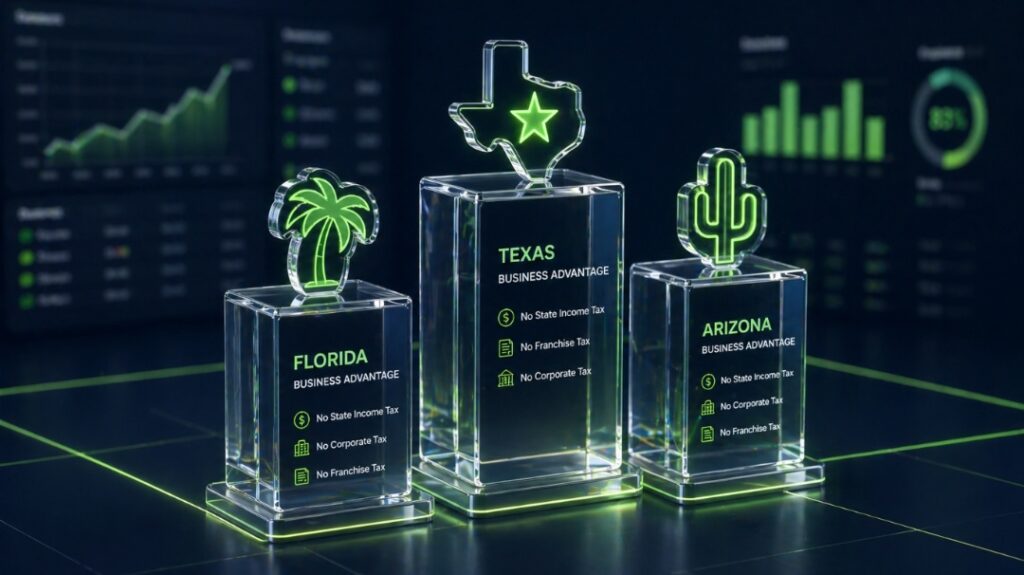
The Strategic Battleground: Decoding State-Level Tax Neutrality
For the modern digital founder, geography is no longer a constraint, but a strategic asset. As we move into 2026, the migration of 7-figure businesses toward tax-neutral havens has reached an all-time high, driven by the realization that your “where” is just as important as your “what.” Choosing a home base for your LLC isn’t just about the weather; it’s about protecting your bottom line from state-level friction. In this high-stakes landscape, Florida and Texas remain the undisputed heavyweight champions, offering a 0% personal income tax environment that allows entrepreneurs to reinvest 100% of their distributions directly back into growth.
However, the 2026 tax year has introduced a new challenger in Arizona, which has now solidified its position with a highly competitive 2.5% flat tax rate. For many, Arizona represents the “Goldilocks” zone—a balance of low operational costs and a simplified tax structure that rivals the traditional no-tax giants. Whether you are scaling a Wyoming LLC as a non-resident or establishing a physical presence in the Sun Belt, the nuances of franchise taxes, filing fees, and asset protection laws in these three states will define your capital efficiency for the next decade. At Finloxa, we don’t just compare rates; we analyze the “Effective Cost of Operation” to ensure your business home is a fortress for your wealth, not a drain on your revenue.
Inside the 2026 Comparison
Florida: The Strategic Safe Haven
0% State Income Tax | Strong Asset Protection
Florida remains the crown jewel of the American South for high-net-worth digital founders. In 2026, its primary allure is not just the 0% personal income tax, but its aggressive stance on wealth preservation. Unlike many other jurisdictions, Florida offers robust “Homestead Protections” and statutory shields that make it nearly impossible for creditors to touch your primary business assets or residence. This creates a dual-layer advantage: you maximize your immediate liquidity by bypassing state-level income tax, and you secure your long-term legacy through superior asset protection laws.
For the Wyoming LLC owner looking to establish a physical footprint, Florida’s operational costs are highly predictable. While the May 1st Annual Report deadline is strict (carrying a $400 late fee), the base filing fee of $138.75 is a negligible price for access to one of the world’s most business-friendly ecosystems. The state has actively leaned into the “Silicon Slopes” and “Miami Tech” migration, ensuring that the regulatory environment remains lean. At Finloxa, we categorize Florida as the “Wealth Shield”—the ideal destination for founders who have surpassed the $250k annual profit mark and want to stop the “tax bleed” entirely.
Texas: The Enterprise Scaling Engine
0% Personal Tax | $2.65M Franchise Threshold
Texas is built for the “Mega-Scale” mindset. While it shares the 0% personal income tax status with Florida, its corporate structure is designed to support massive infrastructure and high-velocity commerce. The defining feature of the Texas tax landscape in 2026 is the Revised Franchise Tax Threshold. The state has significantly increased the “No Tax Due” limit to $2.65 Million in total revenue. This means for the vast majority of digital entrepreneurs and mid-sized LLCs, the state-level tax burden is effectively zero, providing a massive runway for reinvestment without the complexity of corporate filings.
However, scaling in Texas requires an understanding of the “Trade-Off.” What you save in income tax is often partially offset by higher-than-average property taxes. For a digital business with low physical overhead, this is a winning trade. The Texas “Lone Star” brand also carries significant weight in the B2B sector, signaling a commitment to growth and deregulation. If your 2026 roadmap involves hiring a domestic team or scaling toward an eight-figure exit, Texas provides the corporate machinery and the “Business-First” legal climate necessary to sustain that momentum without bureaucratic interference.
Arizona: The Goldilocks Challenger
2.5% Flat Tax | Low Operational Overhead
Arizona has emerged as the most formidable “Hybrid” state for entrepreneurs who find Florida too expensive and Texas too corporate. By solidifying its 2.5% Flat Tax Rate in 2026, Arizona has positioned itself as the most affordable low-tax state in the Western United States. This “Goldilocks” positioning—not too high, not zero, but perfectly balanced—appeals to founders who want a simple, predictable tax bill while enjoying a significantly lower cost of living compared to the coastal hubs. It is the ultimate “Efficiency Play” for the modern nomad.
The Arizona advantage extends beyond the flat tax. The state has simplified its nexus rules, making it remarkably easy for remote-first businesses to stay compliant without an army of accountants. Furthermore, Arizona’s filing fees remain some of the lowest in the country, and unlike its neighbors, it does not impose a “hidden” franchise tax on small-scale operations. At Finloxa, we recommend Arizona for the “Growth Phase” founder—someone who is prioritizing low personal burn rates and high-speed execution. It offers the stability of a low-tax environment with the lifestyle benefits of the booming Mountain West tech corridor.
The “Nexus” Trap
Location Matters More Than Registration
The most dangerous misconception in the LLC world is that “Where you register is where you pay.” In 2026, the IRS and state tax boards have synchronized their tracking systems to enforce Physical Nexus laws with surgical precision. If you register a Wyoming LLC but perform 100% of your work from a home office in California or New York, you are legally obligated to pay those states’ high income taxes. The “Nexus Trap” occurs when a founder ignores the distinction between the “State of Formation” and the “State of Operation,” leading to massive back-tax liabilities and “Double Taxation” penalties.
To navigate this trap, you must understand the “Economic vs. Physical Presence” tests. If your physical body is located in a high-tax state, that state generally claims “Sourcing Rights” to your income. Strategic relocation is the only 100% legal way to unlock the 0% benefits of Florida or Texas. For digital entrepreneurs, this means your “Center of Vital Interest”—your driver’s license, your primary bank account, and your physical workstation—must align with your tax-neutral registration. At Finloxa, we emphasize that tax strategy is a “Location-First” game; registration is the paperwork, but your physical residency is the reality that determines your final tax bill.
The 2026 State Relocation Roadmap
Phase 4: Establishing Your Tax Domicile
The Execution Roadmap: From Selection to Sovereign Residency
Choosing between Florida, Texas, or Arizona is only the first half of the battle. The second half is the clinical execution of establishing “Tax Domicile.” In 2026, state tax boards have become increasingly aggressive in auditing founders who claim the benefits of a tax-neutral state while maintaining “ghost footprints” in high-tax jurisdictions. To legally unlock the 0% or 2.5% benefits, you must follow a disciplined four-stage transition process that proves your intent to remain in your chosen state.
Step 1: The Corporate Alignment (Wyoming Integration)
If you are operating through a Wyoming LLC, your first step is to register that entity as a “Foreign LLC” in your target state (Florida, Texas, or Arizona). This creates the legal bridge for your business to operate locally. In 2026, ensure you obtain a state-specific Tax ID (if required, like the Texas Franchise Tax Account Number) and appoint a local Registered Agent. This step ensures that your business and your physical presence are legally synchronized.
Step 2: Securing Physical Nexus & “Abode”
To claim Florida or Texas residency, a PO Box is no longer sufficient evidence for the IRS or state boards. You must establish a “Permanent Place of Abode.” This involves securing a residential lease or property deed and, more importantly, shifting your “Center of Vital Interest.” This means updating your driver’s license, registering your vehicle, and most critically, updating your voter registration. These are the primary documents a high-tax state will demand if they challenge your relocation.
Step 3: The Financial Migration
Update your banking and merchant processing “Physical Address.” Your Mercury, Relay, or Chase Business accounts should reflect your new tax-neutral office address. In 2026, automated “1099” reporting systems often default to the address on file with your bank. If your bank still lists a California or New York address, those states may automatically receive data on your earnings, triggering an unwanted inquiry.
Step 4: The 183-Day Audit Trail
Most states follow the “Statutory Resident” rule—if you spend more than 183 days in a state, they can claim you as a resident. Maintain a digital log of your travel. For digital founders, your cell phone records and credit card transactions serve as a silent audit trail. Ensure the majority of your economic activity occurs within the borders of Florida, Texas, or Arizona. At Finloxa, we advise founders to treat the first 12 months as a “Documentation Phase”—building an ironclad wall between your old tax life and your new financial freedom.
2026 State Comparison Matrix
Operational Costs & Tax Efficiency
Strategic Analysis: Choosing Your Tax Architecture
When comparing Florida, Texas, and Arizona, you aren’t just comparing numbers; you are choosing a fiscal philosophy. In 2026, the divergence between these states has become more pronounced, especially for digital entities operating through a Wyoming LLC structure. The choice essentially boils down to your Revenue Velocity and Asset Profile.
. Florida offers the ultimate Liquidity Advantage. By eliminating state income tax entirely and providing superior Homestead protections, it is the premier choice for founders who want to maximize their take-home pay while shielding personal assets from external liabilities.
. Texas is the Scaling Powerhouse. With its massive $2.65M Franchise Tax threshold, it allows enterprise-level growth without the friction of state-level corporate taxes. It is the only choice for founders aiming for high-volume revenue with minimal bureaucratic overhead.
. Arizona represents Surgical Efficiency. While it carries a 2.5% flat tax, the ultra-low cost of operation and simplified filing system often result in a lower “Total Cost of Business” than the zero-tax giants, particularly for lean, solo-founder operations.
*Data verified for 2026 Tax Year. Texas threshold based on new $2.65M “No Tax Due” rule.
State Compliance FAQ
GOOGLE PAA OPTIMIZED | 2026 UPDATES
Which state is truly the “cheapest” for a Wyoming LLC owner in 2026?
The answer depends on your revenue. If your LLC generates under $1 million, Texas is often the cheapest due to its $0 annual franchise tax filing for small businesses. However, if you require physical residency, Arizona’s low cost of living and 2.5% flat tax might result in lower overall personal expenses than the high-insurance and property tax markets of Florida.
Do I have to pay taxes in my home state if I register my LLC in Florida?
Yes, if you are physically working from that state. Under 2026 Nexus laws, state tax boards prioritize your “physical presence” over your “state of incorporation.” If you live in a high-tax state like California but own a Florida LLC, California will tax your global income. To avoid this, you must legally relocate your tax domicile to a no-tax state.
What is the new 2026 Texas Franchise Tax threshold?
As of the 2026 tax year, the Texas “No Tax Due” threshold has been adjusted to $2.65 million in total revenue. Businesses earning below this amount are still required to file an Information Report, but they do not owe any franchise tax. This makes Texas an exceptionally powerful scaling engine for mid-sized digital ventures.
Is Arizona’s flat tax better than Florida’s 0% tax for small founders?
For solo founders with lean operations, Arizona can be more efficient. While Florida has 0% income tax, its hidden costs—such as higher commercial rent, extreme insurance premiums, and strict $400 late fees for annual reports—can outweigh the tax savings. Arizona’s 2.5% rate is predictable and paired with some of the lowest compliance fees in the US.
Choosing between Florida, Texas, and Arizona in 2026 is no longer a matter of mere preference—it is a high-level strategic decision that dictates your capital efficiency for years to come. Whether you are drawn to the absolute asset protection of Florida, the massive $2.65M scaling threshold in Texas, or the lean, flat-tax simplicity of Arizona, the goal remains the same: ensuring that your physical footprint aligns with your fiscal ambitions.
The era of “accidental residency” is over. As a digital founder, your location is your most powerful tax-saving tool. By strategically situating your Wyoming LLC’s operations in one of these three powerhouses, you aren’t just saving on taxes; you are securing a competitive edge that allows for faster reinvestment and long-term wealth preservation. At Finloxa, we believe that the right state doesn’t just house your business—it accelerates it. The data is clear, the 2026 rules are set, and your next move will define your financial sovereignty.